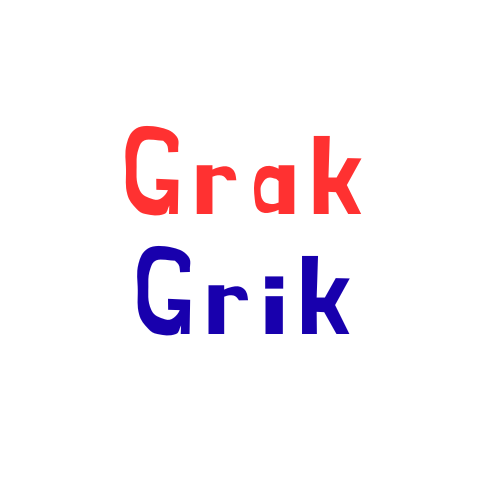
01. A name from an old song
There is a line in "Gambang Semarang", a keroncong song from Central Java, where the singer's heart is caught by the "g'rak g'rik" of the drummer. It is simply the old way of writing gerak-gerik: the small, lively movements that make a crowd lean in and pay attention.
The founders liked the sound. It was playful, it was Indonesian, and it fit the idea they had. Grak and Grik are two sounds that only make sense together. Before a single screen was designed, the name already described the product: two views side by side, worth stopping to look at.
02. Full of information, hungry for meaning
GrakGrik began in 2025 with a question that most of us feel but rarely say out loud. Why do we close our phones feeling emptier than when we opened them?
The early research gave it a name: the zombie scroll. Feeds that keep your thumb moving while your head switches off. People see more than ever and remember almost none of it. And when they do try to talk about something that matters, they meet the curse of the comment section, a battlefield of insults where the loudest voice wins and the thoughtful one quietly leaves.
Underneath it sat two quieter pains. The first was echo-chamber anxiety: the uneasy feeling that your feed only ever agrees with you, so your understanding grows narrow and brittle. The second was intellectual loneliness: the difficulty of finding someone, anyone, who will think a hard question through with you.
Most people skip the comment section for a reason.
03. One wooden table
The first plan was deliberately small. The team pictured a single sturdy wooden table in the middle of a village square. Two chairs facing each other. Two thoughtful people with opposing views. One referee who makes sure the conversation stays fair.
The minimum viable product had one job: to answer whether people would stop, gather around that table, and stay. No big launch and no long feature list. A topic, two positions, and room to explain why. If people showed up, the rest could be built later.
So the core mechanic was born. Open a question. Choose Grak or Grik. Read the reasoning on your side, look across at the other side, and add your own. Choosing a side was never meant to lock anyone in. You can change your mind, deliberately, and the record of what you said before stays honest.
04. From arena to garden
Then came the most important turn in the story. As the founding documents piled up, the team noticed something in its own language. Words like battle, troops, attack and opponent had crept into the plans. An "arena" for "debates". A launch protocol named after a warrior city.
That worried them. Talk about fights and you get people who came to fight, and you end up rebuilding the comment section you were trying to get away from.
So in late 2025 they audited every core document and rewrote it. Battle metaphors became gardening ones: planting seeds, first members, facilitators. The provocateur became a facilitator of perspectives. Points would go to people who helped others understand something. And the goal changed: GrakGrik would collect as many sides of a question as it could, so the person asking could make a better call.
An intellectually resilient society.
A community that grows with diversity.
Clearer decisions, together.
05. Two old phrases, one charter
To anchor the new spirit, the founders reached back to two phrases every Indonesian knows. The first is Bhinneka Tunggal Ika, unity in diversity, the national motto. The second comes from the same old Javanese poem: Tan Hana Dharma Mangrwa, often read as "there is no truth that is divided."
At first glance they seem to pull against each other. Why build a platform of two sides if truth is one? The way the founders see it, nobody gets to own the truth alone. It is found together, through honest dialogue, reflection and the courage to look at the other side. Those ideas became a short founding charter.
- 1Bhinneka Tunggal Ika. This community lives because of diversity. A different mind is not a threat, it is a source of growth.
- 2Tan Hana Dharma Mangrwa. Truth does not belong to one voice. Dialogue and shared reflection are how we see more clearly.
- 3The right to choose. Everyone may stand with Grak or with Grik, without fear of being pushed aside.
- 4Growing together. The point is to learn something, whichever side you start on.
- 5Intellect as the purpose. Sharp thinking, open to difference, rooted in curiosity.
06. Meet Bima
Every product decision at GrakGrik is checked against one person. His name is Bima. He is somewhere between 25 and 35, a young professional or a postgraduate student. An engineer, a researcher, a writer, a consultant. He does not open an app to kill time. He wants to come away knowing more.
Bima's personal motto is simple: "I don't need to always be right, but I must always keep learning." He wants to understand why smart people reach completely different conclusions. He wants his screen time to feel like an investment in his mind, not a cost. And he wants a place where he can explore even a controversial idea without being attacked personally.
So GrakGrik tries to keep things calm for him. It even lets him skip a question, because not choosing is also a choice. That small feature works as a bridge of tolerance: Bima can watch first, then vote, then finally speak. Spectator, voter, player. What counts is what he adds to the discussion.
07. One format, many rooms
Once the purpose became clearer decisions, the Grak and Grik format turned out to fit far more than philosophy. It became a simple frame for asking for advice: one position, the alternative, and a discussion where others share what actually happened to them.
First hire: a cheaper generalist, or an expensive specialist?
A higher salary at a company whose culture you dislike. Take it?
Each audience got its own line. For students and educators: train the mind, build the argument. For business owners: clearer decisions, stronger business. The same two-sided frame, spoken in the language of each room.
08. Where it is heading
GrakGrik is growing slowly on purpose, and the team spends most of its time on the first members. The newest version is being shaped as a safe place to talk, and the team has been exploring how the format can support 21st-century learning in Indonesian schools, where students learn to weigh a question instead of memorizing an answer.
The web platform comes first. A mobile app follows once the community proves it keeps coming back. The test for every version is the same. Do people leave a discussion understanding the question better than when they came in?
A place to think a question through, with people who see it differently.